

Tinnitus Ripple

Will Sedley and team conducted trials on a new audio therapy for tinnitus at Newcastle University, publishing this paper in 2025.
They made the entire project open source – you can see the files here You can use this link to find and download the files but you need to be sure to get the correct frequencies and correct hearing profiles for you and your tinnitus.
Acoustic Ripple Therapy (ART), also referred to in publications and trial materials as a “spectral ripple”, is an audio intervention designed to reduce perceived tinnitus loudness by presenting broadband sounds that are modified in a frequency-specific, time-varying way. The approach is intended to be deliverable at scale using everyday devices (smartphones or computers) and headphones, without specialist clinical hardware.
In the Newcastle University-led study, participants listened to specifically modified sounds for one hour per day over six weeks.
Skip to the DAW experiment section
Findings
A blinded randomised crossover trial was run fully online, comparing an active stimulus against a perceptually near-identical sham stimulus, with two 6-week listening periods separated by a 3-week washout. Fifty-three participants completed this blinded crossover trial.
Key reported outcomes:
- Self-rated tinnitus loudness reduced significantly after the active intervention (p = 0.012), but not after sham (p = 0.916).
- The loudness reduction persisted for at least a further three weeks after listening stopped (as summarised in the paper highlights).
- Tinnitus distress measures decreased in both listening periods, which the authors interpret as supporting tolerability of the intervention and trial process (while also implying that non-specific effects can improve distress).
They frame the method as potentially generalisable across tinnitus types and suitable for automated, low-cost delivery.
Mechanism of Action
The central hypothesis is that tinnitus is supported, in part, by abnormal neural synchrony across frequency channels.
The intervention introduces a “cross-frequency de-correlating” modulation of broadband sound intended to eliminate correlations between frequency pairs close to the tinnitus frequency, thereby reducing cross-frequency neural synchrony and making tinnitus quieter.
A lay explanation from Newcastle University describes the aim as making populations of brain cells responding to different sound frequencies activate at different times rather than “chant together”, which is proposed to make the tinnitus activity easier for the brain to ignore.
Spectral Ripple
The trial documentation (ISRCTN PDF) describes the carrier sounds and the modulation approach in practical terms:
- The carrier audio: hour-long sequences of non-overlapping 4-second broadband harmonic complexes spanning approximately 1–16 kHz.
- The modulation concept: “dynamic spectral ripple” modulations applied to tinnitus (active) or non-tinnitus (sham) sections of the sounds.
- The ripple modulation rate is itself constantly modulated over a one-octave range.
- Two alternative implementations of the modulation are described:
- as an amplitude modulation with a stated range of 0–2
- or as a phase modulation with a stated range of 0 to 2π
Replicate the Treatment
The easy way is downloading the most appropriate sound file from the link above but if you can try making it yourself (bearing in mind this sin’t quite complete). Based on the trial documentation, to implement this yourself would need:
- Identify tinnitus pitch or most dominant tinnitus frequency
- If more than one tinnitus identify a frequency range
Technical start point:
Sample rate: 48 kHz is acceptable but 44.1 kHz works. If you intend to span reliably up to 16 kHz, 48 kHz gives a little more headroom and gentler anti-alias filtering.
Bit depth: render to 24-bit WAV for processing; dither to 16-bit for playback compatibility.
Loudness: keep conservative headroom throughout (for example, peak below -3 dBFS before final limiting, if any). Prioritise comfort over level.
Generate the carrier:
- Create a 60-minute file comprised of consecutive, non-overlapping 4-second segments.
- Each segment is a broadband harmonic complex spanning roughly 1–16 kHz.
- “Harmonic complex” generally means multiple harmonics of a fundamental. The documents do not specify the fundamental(s), harmonic count, level distribution, or whether fundamentals vary between segments.
Generate the ripple:
- Build a time-varying ripple pattern across frequency: peaks and troughs along the frequency axis that move or change density over time.
- Continuously vary the ripple density (“spectral modulation rate”) over time within a range where the upper bound is double the lower bound (one octave).
Apply the ripple across the tinnitus frequency range. Although phase modulation was deemed to work best, you have a choice between that and amplitude modulation.
- Amplitude implementation: the ripple function acts as a multiplicative gain across frequency bins (depth controlled so it remains comfortable and “perceptually near-identical” across conditions).
- Phase implementation: the ripple function perturbs phase across frequency bins (or across band-limited components), with the stated phase range.
Listen for one hour a day for 6 weeks to replicate the trial, then do not listen for 3 weeks after to see if any effect is stable.
Don’t listen too loud, stop if you feel it’s making you worse.
Experimental Variation
As the spectral ripple is (kind of) a moving comb filter, can we apply the principle of the therapy and create a similar effect with something that’s designed to have a musical implementation?
For something inside a DAW you can use any comb filter device. I’ve used Ableton Auto Filter below.
Always make sure volume levels are low and safe for your ears.
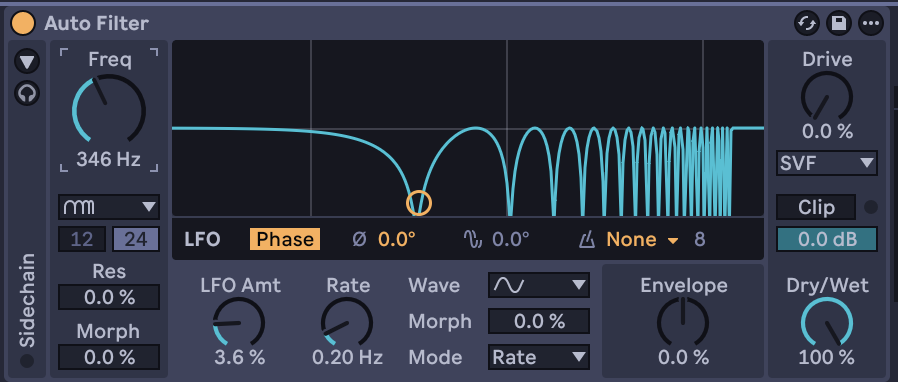
The frequency and LFO settings are arbitrary here, they’re something to experiment with.
Select the comb filter type (under the frequency dial) and you’ll see these options.
The LFO is set to alter phase by default but if you click on the button you can switch to spin. Phase sets a fixed offset between the left and right channels, spin sets a diverging offset between the channels.
Experiment with:
- Frequency start point
- Modulating the frequency with an LFO
- Changing LFO rate (what about Theta and Alpha bands?)
- Changing LFO amount or modulation it
- Changing these with spin vs phase
- Changing the sound being filtered
- Will always need broadband content
- Try pad, noise, harmonic complex etc
In tandem with some of the AM experiments on the page in ‘Experiments’ you can try adding elements and even crossing over techniques to see if any benefits are gained or if they diminish.
No More Detail on the Newcastle Sounds?
There is a much more detailed and reasonably technical way to describe the implementation from the Newcastle University trial. However, I’d be printing something I didn’t fully understand.
Rather than give a load of equations I’ve just given an outline of the trial here. If you’re more technically minded and use things like Matlab then the details in the linked documents to give you a good start point.