Musical Neuromodulation

Musical Neuromodualtion is my variation of the Acoustic Coordinated Reset Neuromodulation treatment. I took the original principles and created a broad sequence that can be used regardless of tinnitus tone matching.
Read the information or skip straight to the how-to
Neural Synchrony
The original therapy and device operates on the principle of neural synchrony. Eggermont and Tass outline this in their 2015 paper, updating on trials for the ACRN device.
They frame tinnitus as a disorder of maladaptive neural synchrony. The core idea is that changes in auditory input, most commonly hearing loss or cochlear deafferentation, can push central auditory networks into abnormal patterns of rhythmic activity and coupling between neurons. Over time, these patterns become self-reinforcing through plasticity, so the brain effectively “learns” a stable tinnitus-generating network state.
What Happens in the Brain?
ACRN is designed to change the timing relationships inside tinnitus related brain networks. Rather than trying to cover up the tinnitus percept (masking), it aims to reduce the abnormal synchrony that helps tinnitus persist.
When the ACRN tones are presented, they repeatedly stimulate several frequency channels near the individual’s tinnitus pitch. In the coordinated reset model, each tone is intended to produce a small phase shift in a subpopulation of neurons, and the pattern across tones is intended to nudge different subpopulations out of alignment with each other. The immediate goal is desynchronisation: reducing the degree to which tinnitus related neurons fire in a tightly coupled rhythm.
In EEG studies of acoustic CR like stimulation, tinnitus improvement during stimulation has been associated with changes in oscillatory power in auditory cortex regions, commonly described as reduced delta activity alongside increased alpha (and sometimes changes in gamma), consistent with a shift away from a tinnitus associated rhythm profile. These are correlational markers, not direct proof of mechanism, but they are often cited as physiological support for the desynchronisation hypothesis.
Cumulative changes across sessions are theorised to create a symptom reduction that lasts beyond the listening periods, to exploit learning rules such as spike timing dependent plasticity (STDP). If a network repeatedly spends less time in a synchronised state, the synaptic connections that support that synchrony are hypothesised to weaken over time. Tass and colleagues describe this as “unlearning” of pathological connectivity and synchrony (the brain un-learns creation of the tinnitus signal).
If the therapy is doing what the theory predicts, the subjective changes would be expected to align with reduced network reinforcement of the tinnitus percept. That could present as reduced loudness, reduced intrusiveness, or reduced fluctuation triggered by quiet settings, stress, or fatigue. However, tinnitus is highly heterogeneous, this treatment is unlikely to work for all, so response patterns vary and not everyone benefits.
Research
There have been several published studies of the technique, delivered via a proprietary device:
The papers trialled out additional tones either side of the tinnitus frequency but found they did not work as well as the two tones either side.
The systematic review stated ‘A total of 8 studies were eligible for being reviewed comprising a total of 329 patients. Overall, the evidence level of the published literature was low. The main findings in the included studies were that acoustic CR neuromodulation was safe and well tolerated and most patients reported reduction of tinnitus symptoms. The neurophysiological basis of the method was claimed to be desynchronization, anti-kindling, and change of abnormal frequency couplings in a widespread tinnitus network comprising both auditory and non/auditory brain areas based on EEG analyses’.
My Working Theories
Based on all of the info I have a few things that my version of the therapy is aiming to do:
- Residual Inhibition: Aiming to extend any RI effect the sequences have
- The sequences interrupt the misfiring that creates tinnitus or the central gain being turned up.
- Neural synchrony
- Address the rhythmic misfiring of neurons
- Heterogeneity: some forms
- Because the sequences don’t rely on matching a tone the focus is on the whole range of tinnitus sounds and doesn’t need a specific tinnitus profile.
- Tonotopic mapping: universal
- The sequences are designed to cover the whole tonotopic map and fire neutrons across the whole auditory cortex.
- Perceptual grouping
- Using tones evenly spaced on the musical (logarithmic) scale brings familiarity and listening comfort. Leading to stronger perceptual grouping and attention.
How-to Guide
The treatment is specific on timing and spacing of tones. I didn’t agree with the tone spacings but the timing I did agree with.
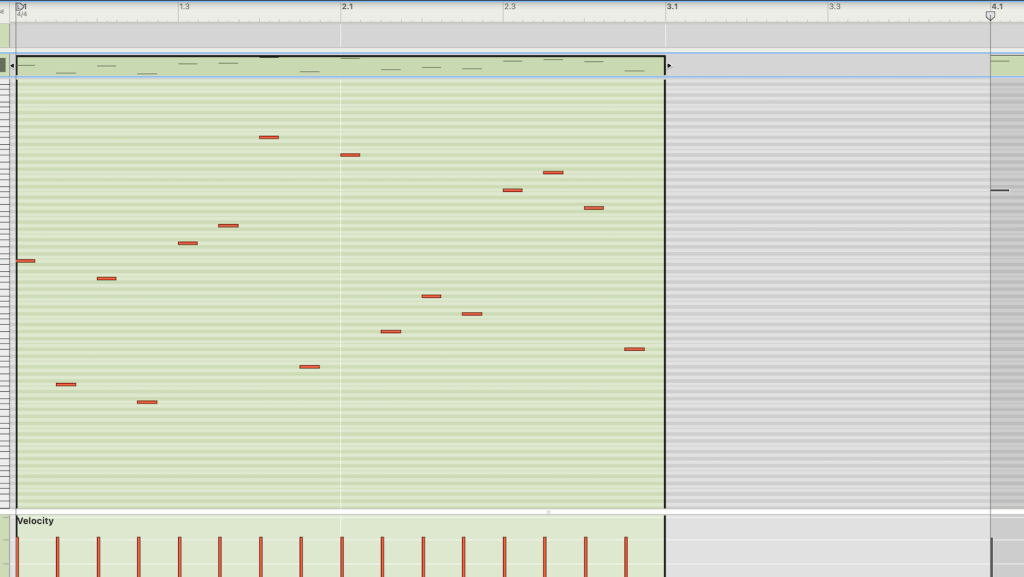
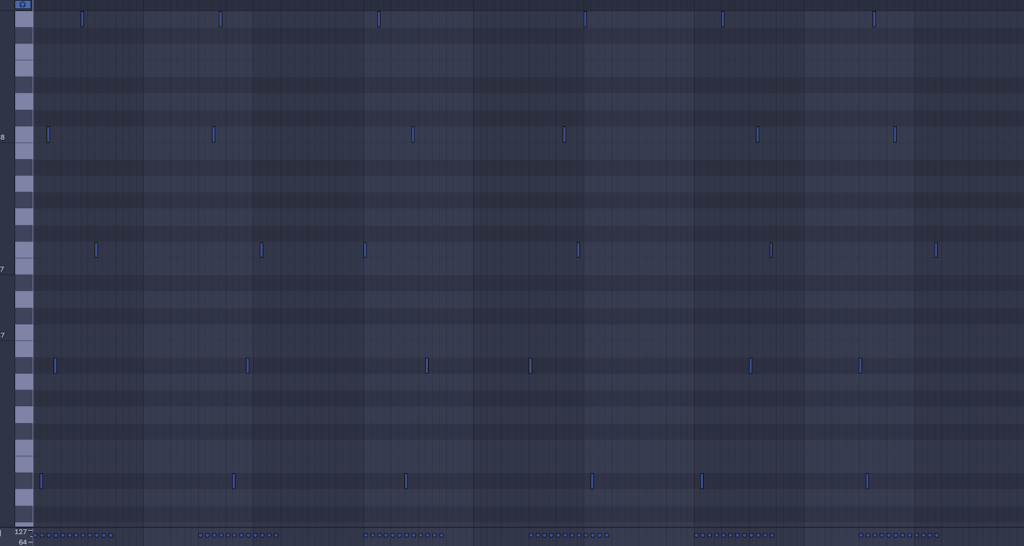
The closest link to the timing for me was to have the BPM on your DAW set to 120. Use 16th notes with a space between each note and the note lasting for just the 16th.
The treatment played 4×4 tones. I separated the tones out in the original sequence so there are 16 total, played in random order and the break between the tones was 50% of the sequence.
Some of my later variations have used 12 tones spaced at 7 semitones. with a 100% break time.This wasn’t a scientifically conscious decision, just that the 7 semitone spacing was nicer to listen to and you could only fit 12 tones comfortably into hearing range.
Using Reason 13
Using Ableton 12
The sequence plays through once in a random order before the pause. No notes repeat in that single sequence.
The sounds used is a sine wave. DAW’s being as they are we aren’t necessarily getting a ‘pure’ sine wave, but that’s fine. You can experiment with analog modelled instruments like Ableton’s ‘Analog’ where there are harmonics, see how each works.
The envelope of the sine can be slightly variable, what matters is that we’re activating the circuits that recognise and therefore pay attention to things like speech. The sound needs to start reasonably quickly, with a very low release time. You can shape it with the ADSR until you find something that feels good, though don’t make it too slow to start or finish.
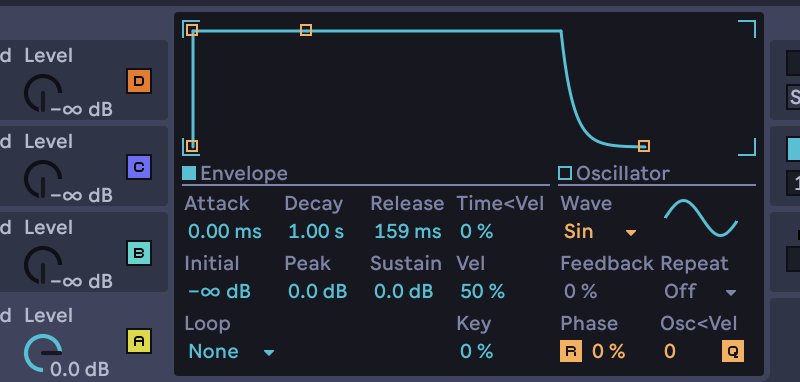
In this example I used Ableton Operator for the sine.
A single operator with no attack, which can sound a little clicks but that's what I wanted here. You can try variations but once you get past 100ms it loses something for me.
Here I haven't used the sustain level, instead I use the note length and then a very low release. You can vary this by setting the sustain to 0 and using the decay to control the length.
And that’s kind of it. The treatment is ridiculously simple to re-create.
Experiments!
1. Tone Spacings
Is the whole range of hearing needed for the effect to work?
Is it working because of certain frequencies, possibly the highest ones?
Try out different groupings of tones around narrower spacings. Break into 2 halves or break into sections, and try lower and higher sequences independently.
- 16 note sequence, separate out into 8 note sections. Try different banks of 8 notes – always adjacent notes – and see what happens
- 12 note sequence, same thing with 6 note sections
Either repeat the notes twice per sequence or change the sequence length.
As an additional test try using different sections as blocks in a composition. For example:
- Block 1 = notes 3-8
- Block 2 = notes 7-12
- Block 3 = notes 5-10
And so on until you’ve covered each block (7 blocks total). This becomes your sequence, randomising each block then repeating the sequence of blocks, maybe even randomising the order of the blocks.
2. With Modulation
Applying Amplitude Modulation to the tones to gauge any additional effects.
Using the guide in the AM experiments page apply 10Hz AM to the audio channel so every tone is affected. Try varying the speed of the AM and the depth. See what happens with these variations.
You’ll get audible sidebands but they’re part of the effect. If you wanted to lose them you can use experiment a little further and cut off the sidebands with a band pass filter set to follow the keyboard.
3. Narrow Noise
Instead of a sine wave try a narrow band noise as the note.
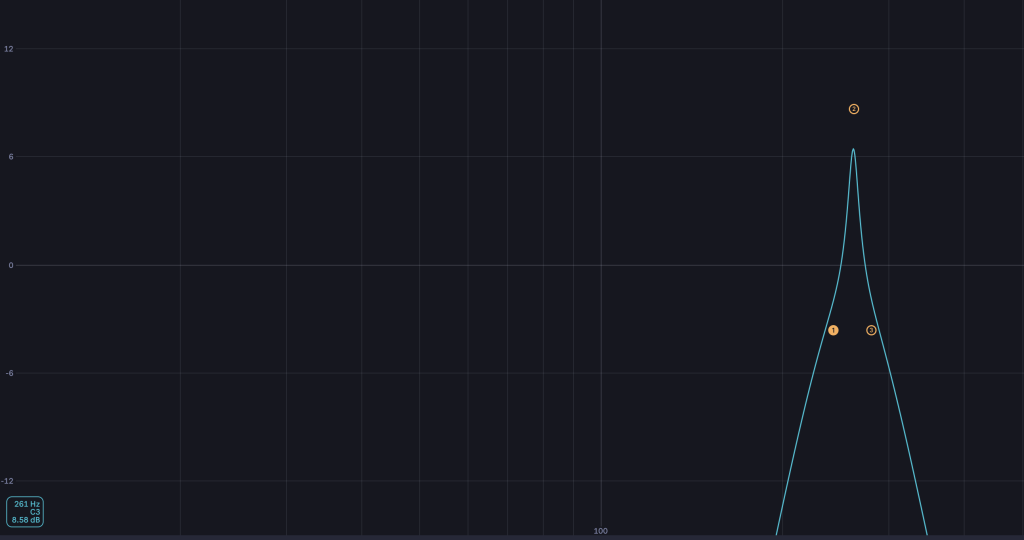
You can achieve this by EQ’ing out a tiny band of white noise at (for example) C3, then loading it into a sampler so you can play the notes with this narrow noise.
In the example below I’ve cut noise either side and boosted around C3 using the EQ8 device in Ableton. There are far more surgical EQ devices you can do this with.
Experiment with the width of the noise and see what works best for your ears.
4. Spatial
If you’ve got access to spatial tools (Envelop for Live, Dolby built into Logic Pro X) you can place the tones into a 3d space.
Because we are attuned to spatial cues this can further drive attention and potentially increase the active nature of the sequences.
Experiment with variations like
- Alternating sides per note
- Completely randomise the position in 3d space
There’s a lot you can try with this method. I’d aim for as random as you can so there isn’t a pattern to latch onto.
5. Binaural
This will take a little bit of playing but you can create a full length sequence and then create another at a consistent 10Hz difference to simulate a Binaural Beat.
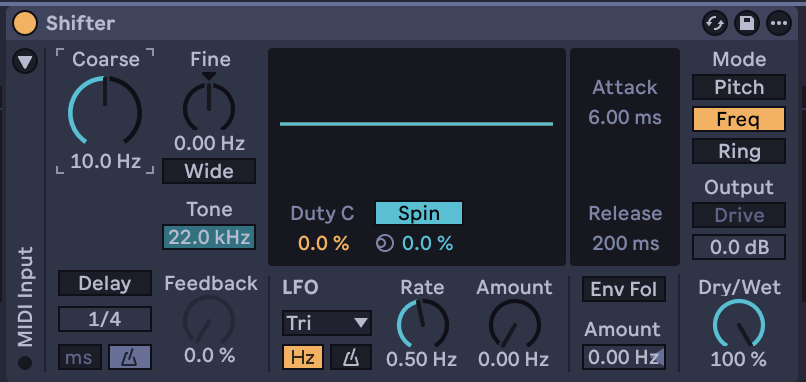
Complete your randomised sequence for its full length. Export the audio (or bounce to new audio track) then shift the pitch of the bounced audio by 10Hz. Play both side by side and you’ve got a hybrid
You can do this with a Shifter device in Ableton quite easily, turned up to 100% and using the frequency setting