

Amplitude Modulation
Amplitude Modulation (AM) is turning sound off and back on again.
It’s as simple as that.
However, at the brain and auditory system level there’s more complexity underlying the simplicity.
How We Perceive AM
The ear takes the vibrations in the air (the sound) and converts it to nerves firing.
Because our hearing is wired to perceive envelopes (the attack, decay, sustain and release of a synth helps to mimic real world envelopes that determine a lot of the characteristics of a sound) we pay close attention to this on/off firing.
At slower modulation rates the firing of these nerves can show phase locking. Essentially the firing locks to the frequency, so in 10Hz AM the firing locks to 10 oscillations per second (10 on/offs per second).
Speed matters. The higher the oscillations the less precision there is in phase locking.
How May it Affect the Brain?
This is slightly debatable depending on the source.
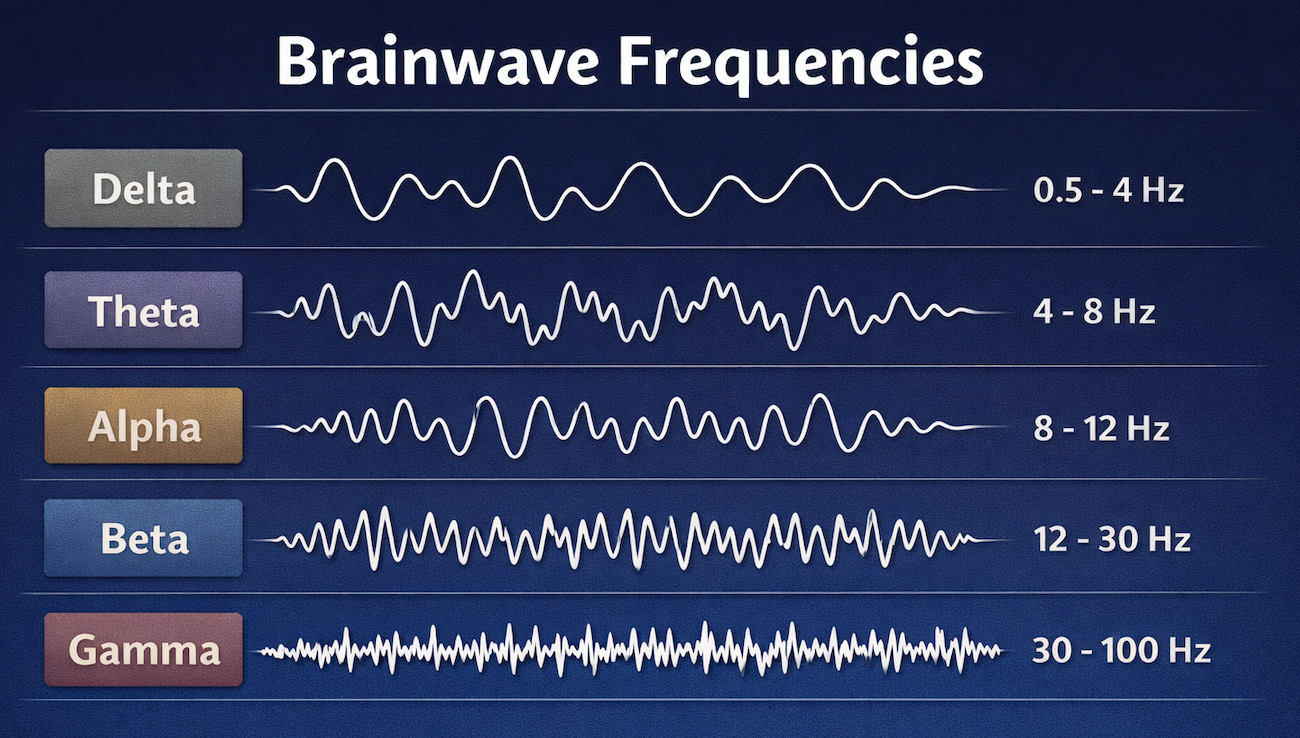
Studies of tinnitus patients show a reduction in the Alpha power brain waves, specifically the 8-10Hz, the 10-12Hz appeared normal. Alpha power has been proven to be reduced whilst receiving auditory stimuli – listening to stuff. This makes a lot of sense when you consider that problematic tinnitus involves the person paying attention to it.
The reduced Alpha is described in this paper by DeRidder et al where they say ‘thalamocortical dysrhythmia (TCD). In deafferentation, TCD is characterized by a slowing down of resting state alpha to theta activity associated with an increase in surrounding gamma activity, resulting in persisting cross-frequency coupling between theta and gamma activity’.
The reduced Alpha is part of the prediction model of tinnitus proposed by Sedley et al. Where ‘gamma relates to prediction error (surprise), beta to predictions, and alpha relates to precision’. The reduction in Alpha would play a role in prediction error where the tinnitus signal is reinforced.
Amplitude Modulation is hypothesised to synchronise Alpha brain waves. A small study has shown that during listening they do not synchronise, however this is to be expected when listening given other findings.
This study shows rapid modulation in music enhanced brain coupling in users with attention difficulties (ADHD), supporting the notion that AM can be integrated into music to improve focus.
Isochronic beats (also called isochronic tones) claim that the phase locking translates through to the brain and influences brainwave patterns, creating Alpha phase locking.
Application
This technique is used and has been researched by Brain.fm in their music designed to increase focus. Endel have produced a white paper along similar lines for their focus music.
A recent systematic review of binaural and isochronic beats didn’t come out with an endorsement but said that further research is recommended, supporting a possible mechanism.
The Neff et al study in 2017 that matched tinnitus frequency and modulated at 10HZ found ‘these results imply that AM sounds, especially in or around the tinnitus frequency, may induce larger suppression than unmodulated sounds’.
How-to Guide
You can AM sounds really simply in standard DAW software using either:
- Tremelo style effect that allows you to set a square wave as the modulator
- Volume button you map an LFO to using a square wave modulator
Either calculate the tempo for the desired speed and sync the rate, or use it in frequency and manually enter the exact frequency you want.
I usually match the rate so that everything flows musically around the sound you use AM on. For example 16th notes at 120bpm is 8Hz and 16th notes at 150bpm is 10Hz.
AM creates artefacts so run it though a spectrum analyser to see what you’re adding. The more you turn up the rate the more artefacts you get. Specificallyy, AM creates sidebands – multiple related frequencies above and below the carrier frequency. Try it out on a sine wave, as you increase the rate you’ll see the sidebands increase.
Volume shaping creates additional sounds, sometimes the steep on and off signals result in clicking sounds. You can smooth the shape the help get rid of these.
Below are two methods to try out using Ableton Live stock devices.
Tremelo Example
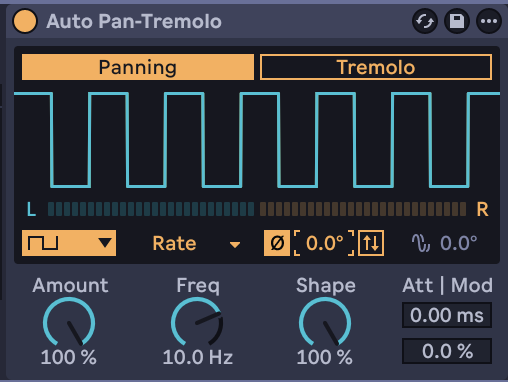
Using the Auto Pan-Tremelo effect unit you can create this easily.
I selected the square carrier, kept the default rate matching, moved the shape to 100% so it's an on/off square and set the phase to 0 (the phase is above the shape dial)
Setting the phase to 0 stops any panning. Although when you implement these ideas musically you can experiment with panning and see what works.
Volume Example
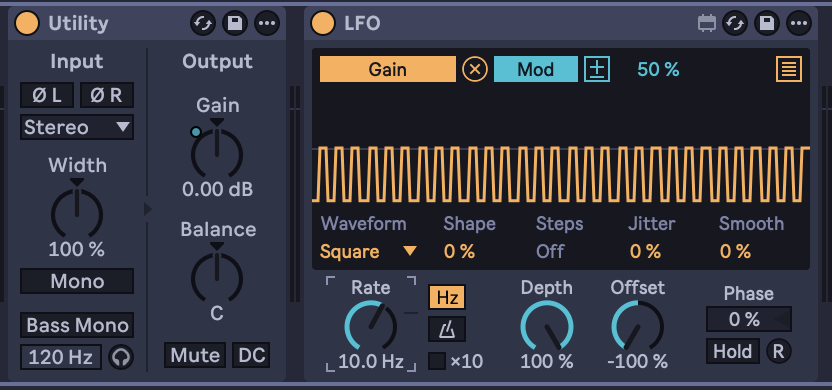
Here I use a Utility for volume and LFO to modulate.
The LFO is mapped to the gain dial, with the waveform (modulator) selected as square
The offset is pulled all the way to -100% so that it goes from the lowest value (minus infinity) to the highest value (0dB). Rate set to 10Hz.
For both of these you can ease the settings to get rid of the audible clicks.
On the Auto Pan-Tremelo device use the shape dial if you do hear clicks, though it’s quite clean in my experience. Change the wave to a sine, set it at 100% and you’ll see it looks like a square wave with rounded edges – dial the shape down to smooth it further, becoming a sine wave at 0%.
On the volume method, use the smooth setting on the LFO, increase it until you lose the audible clicks. I find it stops clicking at 5% but you can go further to suit your own ears.

Working Theories
If alpha reflects inhibitory gating, then reduced alpha could mean auditory representations (including internally generated ones / tinnitus) are less suppressed and become easier to amplify into awareness.
Reduced alpha can be interpreted as disrupted precision control. Spontaneous activity becomes too “trusted”, making the tinnitus signal perceptually dominant.
In TCD, it is not just alpha amplitude but alpha peak frequency slowing towards theta with elevated gamma and cross-frequency coupling. In that case, interventions that merely increase alpha power may fail unless they also reduce pathological coupling and re-balance network connectivity.
Brainwave chart below and then we move on to experiments!
Experiments!
1. Alpha-band AM - Externalised Gating
If tinnitus involves reduced inhibitory gating in auditory networks, then presenting a gentle alpha-rate AM envelope may provide a rhythmic scaffold that encourages a more gated processing mode – a rhythmic segmentation of gain.
To do this we’re going to use a relatively smooth modulation and vary the depth.
AM rate: 8–12 Hz, test in 3 bands – 8, 10, 12 Hz
Depth: start low (30%) to avoid harshness, then increase (40–70%).
Use sine wave or square wave with smoothing as the envelope
- Use a broadband sound – a harmonic complex, noise, or dense pads. Avoid sparse carriers that make AM too obvious
2. Envelope Shape
Using the same principles, this experiment will focus on the envelope and testing solely how this affects tinnitus whilst listening and for a period after. This is to mimic speech onsets, to test if the transient itself is the active ingredient.
- The depth should be 100%
- Envelopes should be fast onset, no smoothing
- Use square or sawtooth and adjust shape
3. Carrier Shapes
How much does the carrier affect tinnitus?
If you turn up the AM on a simple waveform, you have a very defined set of sidebands. Could the simplicity and the strongly defined harmonic relationship have a greater effect than broadband noises?
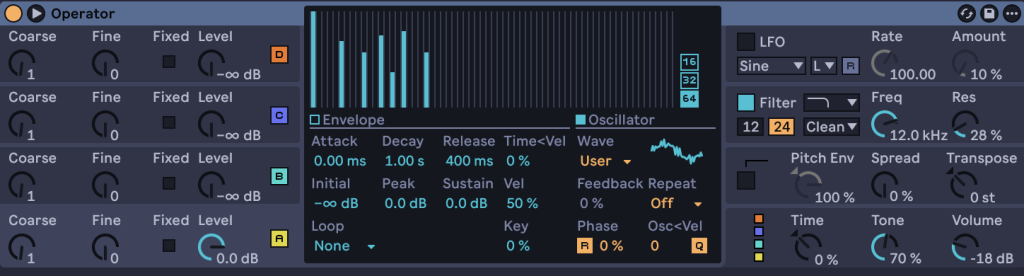
- Use each of the 4 basic waveforms (sine, triangle, square, sawtooth)
- Adjust the depth until you have strongly defined sidebands
- Test depth, increasing up to 100%, to gauge effect on tinnitus
- Experiment with different harmonic structures
- Use Operator in ‘oscillator’ mode with a single operator to draw in harmonics and experiment further
4. Multiband Variation
What happens when we try and stimulate the frequency bands with different rates?
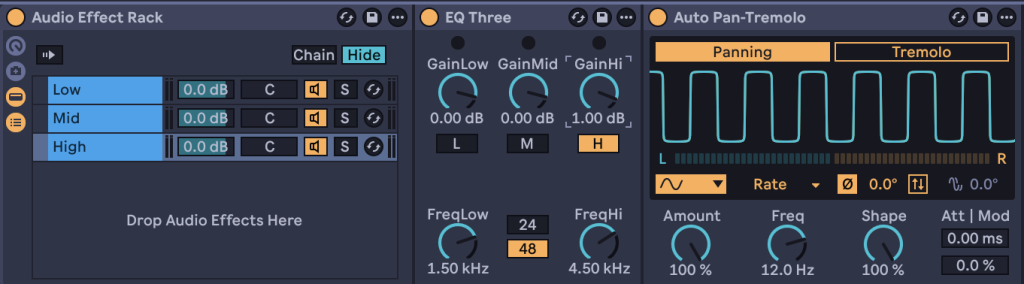
To do this you need to split the frequencies into 3 bands and treat differently. In the example below I have low at 8Hz, mid at 10Hz and high at 12Hz.I set the break points using an EQ3 and turning off the other bands. You’ll see here I added boost because depending on the sound there is likely to be a bit of imbalance in each frequency range. You can change this by looking at the power in an analyser and making a call between that and what your ears tell you.
These are arbitrary AM numbers, something to play with and test. You can also have variable rates and even add an LFO to have moving rates within each band to see what works.
5. Stereo Field
Adjusting the stereo offset creates a big impact on attention and perception. The brain analyses and interprets the sound arriving in each ear to determine location, it creates the illusion of a single central sound when identical audio is played into each ear.
Can we play with this perception to increase attention on the sounds and therefore amplify any effect they may have?
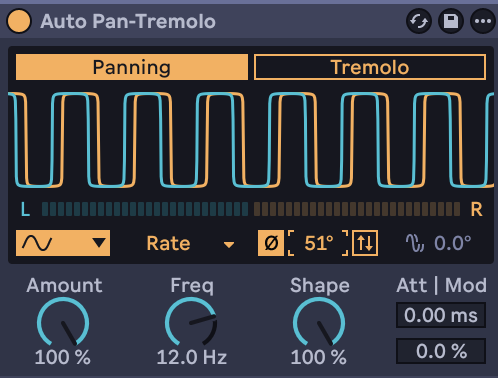
Using the ‘Stereo Offset’ on the Auto Pan-Tremelo device we can increase the spacing of information being presented to each ear.
If we start from 0 where the signals are identical we can increase the spread and measure the effect.
- Try different effect amounts, starting at 40% to see how the stereo is perceived
- Try softer modulator waveforms to see if the effect is rhythmic
- Try an LFO on the stereo offset and experiment with depth and speed
- Match with the AM rate
- Set at relative differences – e.g. 10Hz AM, 12Hz stereo modulation
6 Speech Gating
Building on the principle that speech and many natural sounds have envelope fluctuations in the Theta range (around 4-7kHz), can we stimulate that range to shift auditory processing away from tinnitus?
This isn’t a model that anyone has proposed so it’s purely speculative, but to me it feels worth a test.
To do this you can mirror what we’ve got above with the other experiments in modulating:
- Depth
- Rate (4-5-6-7Hz)
- Modulator at soft (sine) and harsh (square) and softer edged settings
- Test both broadband noise and less dense tones
We want to understand if one rate works better or if they equally work (or indeed don’t work).
As a kind of weird variation we can also talk some actual speech and remove the high frequencies so it loses its intelligibility. Then we can apply the modulation to it and see how that makes the brain react, will a semi-recognisable sound increase attention and a need to process?
7. Multiple Elements
Once we have a solid bed of modulated sound, what are the effects of adding new elements?
Look at
- Randomised, sparse, non-intrusive tones
- Background, gentle soundscape as bedding
- 2-3 additional elements
How will this change (if anything)?
- Is the AM enough as part of a composition
- Does embedding into a composition enhance effects?
- Are there frequency domains that each element has to occupy for maximum efficacy?